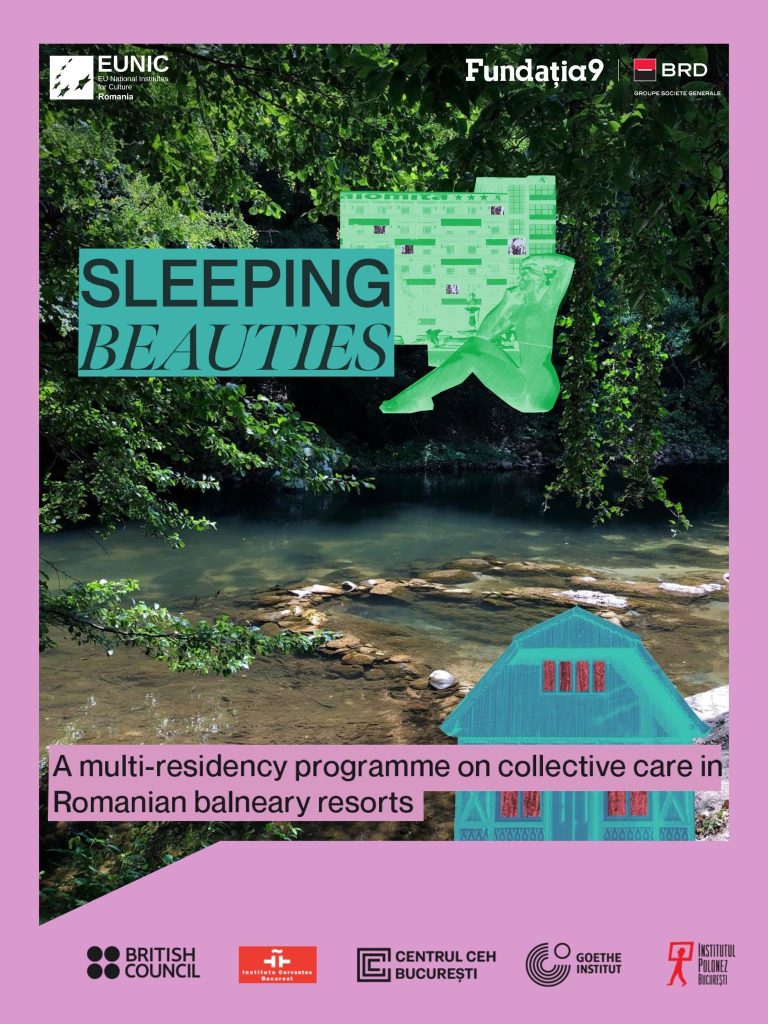
OPEN CALL: SLEEPING BEAUTIES

A multi-residency programme on collective care in Romanian balneary resorts.

Who can apply: Interdisciplinary and performative artists, architects (including landscape architects and historians), filmmakers, researchers, designers and makers, community organisers, and socially engaged practitioners interested in heritage, wellbeing, ecology, public space, and the regeneration of balneary resorts. 

Eligibility: citizens or permanent residents from Czech Republic, UK, Germany, Poland, Spain, and Romania

Period of residencies: Two (2) weeks at various dates between July to September 2026 (see below for exact dates)

Place of residencies: balneary resorts across Romania

Submission deadline: 21st of May 2026

About the Project

SLEEPING BEAUTIES is a multi-residency project designed and developed by EUNIC Romania. It involves six cultural institutions operating in Romania – the British Council, the Czech Centre, the Goethe Institute, the Cervantes Institute, the Polish Institute and Fundația9, each engaged in supporting one residency. 

EUNIC – European Union National Institutes for Culture – is Europe’s network of national cultural institutes and organisations, with 39 members from all EU Member States and associate countries. 

The project was framed by this consortium of European partners, in collaboration with curator Ilinca Păun Constantinescu – PhD, President & Founder of Ideilagram Association, Co-founder of the Architecture Office Ideogram Studio, Lecturer at Ion Mincu University of Architecture and Urban Planning Bucharest, Department of Theory and History of Architecture, coordinator of MuzA – the Museum of Architecture in Romania and its itinerant national programme.

Already an established artist residency programme of the EUNIC Romania cluster, Sleeping Beauties is the third edition following Flowing Streams (which explored water as a social connector) and Reclaiming Post-Industrial Futures (which focused on post-industrial heritage). To see how last year’s residencies unfolded, we invite you to watch this video documentary

Local context

Romania’s balneary resorts, once carefully designed microcosms of health, leisure, and collective life, stand today between memory and renewal. Built around mineral waters, therapeutic practices, parks, and public life, these spa towns shaped landscapes, communities, and everyday cultures across the country. From imperial-era resorts and early modern park-cities to socialist infrastructures of care and seaside tourism complexes, they played a major role in Romania’s cultural and urban history.

After 1989, many entered a long period of decline. Buildings were abandoned, treatment facilities closed, public spaces deteriorated, and coherent systems of care were fragmented through privatisation and the lack of long-term vision. Yet beneath this visible erosion lies a remarkable and still active potential: architectural heritage, extraordinary natural resources, layered memories, and local organizations imagining new futures for these places. In the absence of large-scale top-down solutions, local initiatives are the ones creating new models of regeneration through research, culture, restoration, advocacy, and community engagement.

Today, these resorts are increasingly being rediscovered not only as heritage sites, but as living cultural landscapes. Their value lies in historical buildings and wellbeing, but also in their capacity to inspire sustainable ways of thinking about ecology, public space and tourism. The selected places reflect the richness and diversity of this landscape: the Austro-Hungarian elegance of Borsec, the Roman and imperial legacy of Băile Herculane, the socialist modernism of Amara, the layered seaside development of Eforie and Techirghiol, and the early 20th-century “park-city” model of Băile Govora. Together, they form a palimpsest of architectural styles, planning ideologies, and relationships between nature and the built environment.

Like in the sleeping beauty metaphor, what appears dormant is waiting to be reawakened. These resorts are no longer remnants of a bygone era, but fertile places for collective imagination towards sustainable futures.

SLEEPING BEAUTIES is a project that works with representative balneary resorts and local communities across Romania, offering a broad view of the diversity, heritage, and renewed potential of these remarkable cultural landscapes:

  • BORSEC – a mountain resort shaped by Austro-Hungarian heritage, mineral waters, and distinctive wooden villa architecture, animated today by community-led cultural action;
  • BĂILE HERCULANE – one of Europe’s oldest thermal resorts, where Roman and imperial heritage meets ecological and civic revitalisation along the Cerna river;
  • AMARA – a modernist spa town where socialist-era architecture of care, collective memory, and active treatment infrastructure remain visible and relevant;
  • EFORIE & TECHIRGHIOL – Black Sea resorts where interwar heritage, seaside modernism, mass tourism, and contemporary cultural initiatives overlap;
  • BĂILE GOVORA an early 20th-century park-city where architecture, vegetation, and therapeutic culture form a unique landscape of care. 

The programme is an invitation to explore these remarkable places and their layered histories, to connect with local initiatives and communities and to engage with organisations working across heritage preservation, architecture, archival research, cultural programming, ecology, and community development.

Through artistic, spatial, performative, or research-based practices, participants are invited to contribute to the ongoing renewal of these towns and to rethink heritage as a resource, care as a collective practice, and balneary resorts as laboratories for future ways of living.

Conditions of the Residency:

The residency covers travel costs from the selected applicant’s country of residence (up to 500 Euro), accommodation within the premises of the host organisation, some meals, a fee of 700 EUR and a 300 EUR production budget.

The programme encourages and assists the insertion of the resident into the everyday life of the town. The host organisation will provide mediation and knowledge of the local context, connect the resident with the local community, and share available resources for research. Communal meals will be organised on occasion. 

Selected residents are kindly informed that the residency will be documented on video, in a format similar to last year – link here

Only individual applicants can apply.*
*Duos may apply, but the amount allocated per residency will remain unchanged, as mentioned above. 

Eligibility and Criteria:

The applicants must be citizens or permanent residents from the following countries: Czech Republic, UK, Germany, Poland, Spain and Romania.

Each residency space is targeting applicants from one country and will select one participant. Please check the list of host organisations and the country eligibility.

We encourage applications from practitioners with diverse disciplinary backgrounds  and artistic approaches: interdisciplinary artists, architects/landscape architects, architecture historians, filmmakers, researchers, community organisers, and socially engaged practitioners with a minimum of 5 years of experience in their respective fields. Please check the eligibility of applicants for each host organisation.

We are particularly interested in practitioners who showcase an ability to work collaboratively and flexibly across disciplinary boundaries; have practices aligned to ecological and sustainable principles of thinking and working; ground their work on decolonial and critical perspectives that acknowledge the interdependencies of different life forms; have experience or interest in heritage, wellbeing, ecology, public space, and the regeneration of balneary resorts.  

We celebrate talent from all backgrounds and we welcome applicants of all ages, genders, and diverse linguistic, cultural, and minority backgrounds, including those from underrepresented communities.

The resident must stay for the entire residency period (between 10 to 14 days) within the time span proposed by each host organisation. 

The resident must organise one public event during the residency (workshop, discussion, performance, gathering, cooking session, or any other type of public format) that will take place in relation to the local community or the residency space. Additional support for event planning and dissemination will be provided. The costs of the event will be supported from the production budget. No other outcome is expected.

The resident will be expected to keep a journal in any type of format: texts, audio-visuals, objects, drawings, sketches, new works, or others. The documentation of the project will be made public.

How to Apply:

Please apply to the residency by filling out this application form* in English by the latest 21st of May, 2026, 23:59 CET.
 

After the representatives from the Sleeping Beauties project and partnering institutions have evaluated the applications, there will be a round of interviews with shortlisted candidates taking place online on the 28th and 29th of May 2026.

Applicants will be notified of the outcome of the selection process by 5th of June 2026. All applicants will receive an answer by email, but due to limited resources, we are unable to give individual feedback. 

*Please be aware that you need a google account to fill out the google form in order to apply to the residency program. 

If you have any questions please contact us at roprojects@britishcouncil.org 

Residencies and Host Organisations

1. AMARA / Local Host: Vira Association

Supported by: The Polish Institute

Open to applicants from: POLAND

Residency Period: 13.07-27.07.2026

Who can apply: The Amara residency is particularly suited to architects/landscape architects, architectural researchers, interdisciplinary artists  from Poland interested in socialist-era modernism and the urban visions embedded in spa infrastructure. We are looking for residents who can critically explore the architecture and planning of mass tourism, public health, and leisure developed during the socialist period, as well as their changing meaning today.

Location: Amara

Website: https://www.vira.ro/proiectehttps://amintiridulciamara.ro/acasa 

 Local context:

Amara is a spa resort where socialist-era architecture remains not only visible but still actively used, making it a valuable case study for understanding the continuity of mass tourism, healthcare, and collective leisure practices shaped during the communist period. The recently published volume “Greetings from Amara! Fragments of Architecture and Collective Memory”, developed by the Vira Association after three years of interdisciplinary research, explores the resort through the lenses of architecture, balneary practices, and social memory. Focusing on buildings such as the Lebăda (the Swan), Ialomița, and Parc hotels, the project highlights how spaces designed in the 1970s as integrated environments of care, combining treatment facilities with cultural and social infrastructure, continue to shape experiences today, even as the resort transitions from a state-supported system to one largely serving retired people. By documenting this “architecture of care,” the research opens a broader discussion about the future of spa towns and the potential of their built environments to support wellbeing and community life.

About the hosts:

Vira Association, founded in 2006 in Bârlad, is a cultural NGO focused on visual documentation, heritage, community development through culture, civic organization, and non-formal education. Bringing together sociologists, historians, visual researchers, and film professionals, the organization works to reconnect communities with their cultural resources by documenting, promoting, and reintegrating local heritage into everyday life. Through research projects, exhibitions, educational programs, and partnerships with local institutions, Vira emphasizes community involvement, long-term collaboration, and the use of cultural assets (both tangible and intangible) as drivers for sustainable local development. Their recent work in Amara reflects this approach, combining research on balneary heritage with public engagement and exploring ways to enrich the social and cultural life of the resort beyond its therapeutic function

2.  BORSEC / Local host: Culturarium Association                    

Supported by Fundația9

Open to applicants from: Romania

Residency Period: 23.07-06.08 2026

Who can apply: interdisciplinary and performative artists, architects/landscape architects, anthropologists and community organisers working between heritage and contemporary culture. We encourage projects that explore local identity, multicultural histories, architecture and ever-present nature through collaborative/participative formats engaging the local community.

Location: Borsec

Website: https://www.facebook.com/AsociatiaCulturariumEgyesulet

Local context:

Borsec emerged as a prominent spa town during the Austro-Hungarian period, when balneary resorts in Eastern Europe became cultural, social, and therapeutic destinations shaped by carefully designed architectural and landscape compositions. Known for its mineral waters and the distinctive character of its built heritage, particularly the wooden villas with richly decorated verandas, carved details, and intricate ornamental elements, Borsec developed as a refined environment that harmoniously integrated architecture, nature, and public space. Over time, however, much of this heritage has fallen into decay due to neglect, fragmented ownership, and the absence of coherent management, affecting both the town’s physical fabric and its cultural memory. Despite these challenges, Borsec retains significant potential, with its architectural identity and natural setting offering a strong foundation for sustainable revitalization through sensitive restoration, community engagement, and contemporary reinterpretation.

.About the hosts:

Culturarium Association is a local initiative based in Borsec that focuses on cultural, civic, and educational development as a means to strengthen community engagement while promoting sustainable tourism and the local economy. Founded by five members who returned to their hometown after their studies, the association works to reposition Borsec as both a livable place and a meaningful destination. Their activities range from community programs for children and adults – such as workshops, cultural events, and festivals – to projects dedicated to documenting, preserving, and raising awareness about the town’s architectural heritage. Through research, public exhibitions, and collaborations with professionals and other organizations, they aim to safeguard traditional craftsmanship, encourage responsible interventions in the built environment, and foster dialogue between local actors, ultimately contributing to a more coherent, culturally rooted, and sustainable development of the spa town.

3. BĂILE HERCULANE / Local Host: LOCUS Association (HerculaneProject)

Supported by Cervantes Institute

Open to applicants from: SPAIN

Residency Period: 27.07- 09.08.2026

Who can apply: We invite interdisciplinary artists and practitioners, landscape architects, ecologists, researchers, and performers interested in the relationship between natural systems, balneary and architectural heritage, explored through the revitalisation of the Cerna riverbanks or other latent public spaces via site-responsive, participatory, and community-oriented proposals.

Location: Băile Herculane

Website: https://herculaneproject.ro/echipa/

 Local context:

Băile Herculane is one of the oldest thermal spa resorts in Romania and Europe, with a history spanning nearly two millennia since its first documentation in 153 AD during Roman times. Shaped by successive cultural influences and reaching its peak in the 19th century under Austro-Hungarian rule, the resort evolved from a medical destination into a vibrant cultural and leisure center, attracting figures such as Emperor Franz Joseph and Empress Elisabeth (Sissi). Its development was driven by the therapeutic value of its thermal springs and its exceptional natural setting, now part of a Natura 2000 protected area. Today, Herculane reflects both the challenges and the opportunities typical of historic spa towns, with a remarkable architectural legacy comprising dozens of listed monuments and strong cultural identity rooted in both history and mythology. This layered heritage, though fragile in places, continues to offer significant potential for regeneration and reinterpretation.

About the hosts:

Herculane Project emerged in 2017 from a group of architecture students – now founders of the Locus Association – who were struck by both the decay and the layered beauty of Băile Herculane’s heritage, initially aiming to raise awareness around the neglected Neptune Baths, the initiative quickly evolved into concrete actions aimed at safeguarding and reactivating the site. Over time, it has grown into a broader civic and cultural platform that combines hands-on interventions, research, advocacy, and community engagement. The NGO plays an active mediating role between authorities, private owners, and local residents within a complex legal and social context, contributing to building collaborations and advancing restoration efforts, including through crowdfunding campaigns and partnerships. Their current activities extend across multiple scales and themes: ongoing work along the Cerna riverbanks through spatial improvements and clean-ups, community mapping and research projects, educational programs such as the summer school “Baia de Arhitectură”, volunteer-led interventions, cultural events and initiatives focused on the rediscovery and activation of thermal heritage. Together, these efforts foster connections between people, nature, and public space, contributing to a long-term, community-driven vision for the sustainable regeneration of Băile Herculane.

4, 5. EFORIE + TECHIRGHIOL / Local Host: Forumul Artelor Vizuale

Supported by the the Czech Centre, the Goethe-Institute

Open to applicants from: THE CZECH REPUBLIC AND GERMANY* 

Residency Period: 10.08-23.08. 2026

Who can apply: We welcome research-driven artists and practitioners interested in the tensions between interwar heritage, post-socialist change, and contemporary mass tourism. Through archival and site-based research, applicants are invited to explore evolving cultures of leisure and translate these layered histories into visual, spatial, narrative, or performative forms.

Location: Eforie Sud
Website:  www.forumulartelorvizuale.ro, www.arhivelelitoralui.ro
* Please note that the German and Czech residencies run simultaneously. Selected artists are free to decide whether or not to collaborate during the residency. 

Local context:

The seaside architecture of Eforie developed in the late 19th and early 20th centuries as part of a broader effort to transform the area between the Black Sea and Lake Techirghiol into a modern balneary and leisure destination. While Eforie Nord grew through multiple independent parceling projects designed by different architects, reflecting both local ambitions and European modernist influences (particularly visible in experimental developments such as the Blank parcel, associated with G. M. Cantacuzino and Horia Creangă), Eforie Sud developed around the vision of Ion Movilă, was originally known as Băile Movilă, later Movilă-Techirghiol, and is considered the first resort on the Romanian seaside. Together, the two areas combined villas, hotels, sanatoria, and public spaces, later expanding through socialist-era mass tourism infrastructure that reshaped the coast for collective leisure. Today, this layered heritage, from early balneary structures to interwar modernism and mass-tourism developments, remains a valuable yet fragile cultural landscape in need of integrated regeneration.

About the hosts:

The Visual Arts Forum Association (FAV), through its Eforie Colorat program, has developed a cultural platform on the Romanian Black Sea coast that combines artistic production, heritage research, and community engagement. At its core is the revitalization of the former Cinemascop summer cinema in Eforie Sud into an active cultural hub hosting films, exhibitions, and events that extend the life of the seaside beyond the tourist season. Complementing this, the Arhivele Litoralului project documents the coast’s history, architecture, and collective memory, bringing together artists and researchers to explore its transformation over time. Together, these initiatives reframe the seaside as a complex cultural landscape and support its sustainable, year-round reactivation.

 6. BĂILE GOVORA / Local Host: Studiogovora

Supported by: the British Council

Open to applicants from: U.K.

Residency Period: 07.09-20.09.2026

Who can apply: We welcome designers, makers, researchers, and interdisciplinary practitioners from the UK interested in spa towns, the park movement, and cultures of wellbeing. We particularly encourage projects engaging with material heritage, spatial design, and the relationship between architecture, landscape, and healing environments. Govora can be explored as a historic “park-city”, where vegetation, water, and architecture were conceived together as a landscape of care. 

Location: Băile Govora

Websites: https://govora.studio 

Local context:

Founded in 1887 at the initiative of Prime Minister Ion C. Brătianu, Băile Govora was developed as a public spa resort inspired by the French “park-city” model, aiming to replicate Western European balneary culture within Romania. Initially built around a central bath establishment and park, the resort expanded in the early 20th century through significant investments in infrastructure, architecture, and landscape design, becoming a thriving town shaped by tourism and private development. During the communist period, mass tourism brought both modernization and the loss of historic buildings, while after 1990 the decline in visitors led to widespread abandonment and degradation of key structures. In recent years, however, restoration efforts supported by public funding have begun to revive parts of the town, with the central park remaining a vital anchor and renewed interest in the resort opening new possibilities for sustainable development.

About the hosts:

Studiogovora was established in 2019 by two architects whose diploma projects focused on the evolution and heritage of Băile Govora. The initiative has since grown into an interdisciplinary laboratory for the town’s cultural heritage, where research meets action and care for the past informs future-oriented visions. Bringing together architects, art historians, cultural managers, and communication specialists – some with personal roots in Govora, others drawn to it over time – the team works through restoration projects, public space interventions, advocacy, education, and community engagement. 

Their activities include organizing events such as the Balneary Architecture Days and the Govora Heritage Lab summer school, while their broader approach combines historical research, hands-on restoration, and participatory initiatives to promote responsible development, slow tourism, and the role of culture in fostering collective wellbeing. As part of MuzA – the Museum of Architecture in Romania’s first four-year curatorial programme, Studiogovora will host the museum’s second itineration in the summer of 2026, becoming one of the first places where its growing exhibition and “living archive” take shape through collaboration with local actors and site-specific knowledge.

European Day of Languages 2025

Institutul Cultural Român / Romanian Cultural Institute prin Departamentul EUNIC și Multilingvism, împreună cu clusterul EUNIC Romania, celebrează Ziua Europeană a Limbilor printr-o serie de evenimente ce vor avea loc pe 26 și 27 septembrie în București.

Detalii și program

Conferința „Multilingvismul în Europa de astăzi”

?️ Data: 26 septembrie 2025

⏰ Interval orar: 10:00 – 13:00

? Locație: ICR (Aleea Alexandru 38)

În deschidere vor lua cuvântul Liviu Jicman, președintele Institutului Cultural Român, și Igor Prokopchuk, Ambasadorul Ucrainei în România, invitat de onoare al acestei ediții. Vor urma prezentări individuale susținute de către invitați din mediul universitar și cultural din mai multe țări.

Târgul de Limbi & Lecții Demonstrative

?️ Data: 27 septembrie 2025

⏰ Interval orar: 11:00 – 17:00

? Locație: Institutul Cultural Român (Aleea Alexandru 38) și Institutul Italian de Cultură (Aleea Alexandru 41)

Aici veți standuri interactive cu jocuri, activități creative, prezentări de cursuri și lecții demonstrative de limbă.

EN:

The Romanian Cultural Institute, through the EUNIC and Multilingualism Department, together with the EUNIC Romania cluster, celebrates the European Day of Languages ​​through a series of events that will take place on September 26 and 27 in Bucharest.

Details and program

Conference “Multilingualism in Today’s Europe”

?️ Date: September 26, 2025

⏰ Time interval: 10:00 – 13:00

? Location: ICR (Aleea Alexandru 38)

The opening speech will be given by Liviu Jicman, president of the Romanian Cultural Institute, and Igor Prokopchuk, Ambassador of Ukraine to Romania, guest of honor of this edition. Individual presentations will follow by guests from the academic and cultural environment from several countries.

Language Fair & Demonstration Lessons

?️ Date: September 27, 2025

⏰ Time: 11:00 AM – 5:00 PM

? Location: Romanian Cultural Institute (Aleea Alexandru 38) and Italian Cultural Institute (Aleea Alexandru 41)

Here you will find interactive stands with games, creative activities, course presentations and language demonstration lessons.

Participants: Institutul Cultural Român, British Council Romania, Istituto Italiano di Cultura di Bucarest, Goethe-Institut Bucuresti, forumul cultural austriac, Instituto Cervantes de Bucarest, Ambasada Ucrainei, Yunus Emre Enstitüsü – Bucureşti, Institutul Liszt București / Liszt Intézet Bukarest, Institutul Camões București – Instituto Camões Bucareste, Centrul Ceh (Czech Centre Bucharest), Institut français de Roumanie à Bucarest și Ambasada Georgiei în România.

OPEN CALL: Hai cu proiectul tău la HEI!

Vii la mal?
Hai cu proiectul tău la HEI!

Invităm comunitățile și grupurile informale din Timișoara să se folosească de spațiul generos din Vila Mal al HEI – House of European Institutes!

– Ești lucrător cultural, artist independent, activist sau faci parte dintr-un grup informal și ești în căutare de un spațiu pentru a organiza evenimente culturale?

Dacă ai nevoie de spațiu pentru ateliere, instalații, proiecții de film, discuții, performance-uri, întâlniri comunitare sau orice altă manifestare culturală, te rugăm să completezi acest formular sau să ne scrii pe e-mail, la adresa hei@eunic-romania.ro, care să conțină:

  • o scurtă biografie a ta sau a organizației tale și link(-uri) de social media
  • o descriere a proiectului/evenimentului pe care vrei să-l înscrii (acest text va fi folosit în promovarea evenimentului)
  • datele posibile de implementare în intervalul august-octombrie 2025 (Vă rugăm să luați în calcul că HEI este deschis între miercuri și duminică.)
  • nevoile logistice

Selecția proiectelor va fi făcută de echipa HEI, în limita disponibilității spațiului.

Proiectele găzduite vor beneficia de promovare pe canalele HEI și acces la resursele logistice ale spațiului (proiector, boxe, ecran proiecție, mese, scaune).

HEI încurajează manifestări multiculturale și perspective diverse, așa că evenimentele incluzive și comunitățile vulnerabile vor fi prioritizate.

HEI – House of European Institutes este un proiect coordonat de Fundația9 si British Council Romania, alături de Rețeaua Institutelor Culturale Naționale din Uniunea Europeană – EUNIC Romania.

Exhibition: Men / Männer – Anke Doberauer

22.08 – 14.09.2025
HEI – House of European Institutes – Vila Mal, Bvd. Vasile Pârvan 1-3
Opening: 22.08.2025, 19:00
Visiting hours: Wednesday – Sunday, 17:00 – 21:00 / Free entry

The exhibition features 22 works, including six life-sized paintings, exploring the subtle and complex relationship between artist and model. Doberauer challenges traditional artistic conventions by portraying the male figure through a deeply psychological and ambivalent lens. Art critics highlight that her works are marked by intense light and rich chromatics, giving the backgrounds an aura of mystery and psychological depth.

These paintings are not mere depictions of figures, but rather confrontations of forces—between vulnerability and power, between desire and control. As noted by Philippe Vergne, French curator and director of the Serralves Museum of Contemporary Art since 2019, “these paintings illustrate the model’s moment of maximum vulnerability, redefining traditional roles and relationships in a society where the masculine often dominates the feminine.”

Anke Doberauer rose to international prominence in the 1990s with her life-sized portrayals of men. In her work, she reversed the traditional artist=male / model=female dynamic.

She studied at the Hochschule für Bildende Künste Braunschweig under Ben Willikens, who—as early as 1991—recognized her outstanding skill and talent. Between 1991 and 1992 she received a postgraduate scholarship at the École d’Art de Marseille-Luminy, where she later taught painting and graphics (1992–1994). In 1993 she was awarded the Schmidt-Rottluff Fellowship, and between 1994 and 1995 received the annual fellowship from the Hessian Cultural Foundation for the Cité Internationale des Arts in Paris. In 1998–1999, Doberauer was an artist-in-residence at Collegium Budapest / Institute for Advanced Study. Since 2003, she has been Professor of Painting and Graphics at the Academy of Fine Arts in Munich and currently lives in Marseille and Munich.

The exhibition is organized by the Goethe-Institut Bucharest and the German Cultural Center Timișoara.
HEI – House of European Institutes is a project coordinated by Fundația9 and the British Council Romania, together with the European Union National Institutes for Culture – EUNIC Romania.
Partners: Timișoara City Hall, BRD Groupe Société Générale

Reclaiming Post-Industrial Futures: About

About the programme

Reclaiming Post-Industrial Futures is a multi-residency programme exploring forgotten industrial heritage sites in Romania as places for collaboration and community building. Developed by EUNIC Romania , the programme involves eight cultural institutions operating in Romania, each engaged in supporting one residency:

  • British Council
  • Czech Centre
  • Embassy of the Netherlands
  • French Institute
  • Italian Cultural Institute
  • Cervantes Institute
  • Polish Institute
  • Fundația9

EUNIC – European Union National Institutes for Culture – is Europe’s network of national cultural institutes and organisations, with 39 members from all EU Member States and associate countries.

The programme was framed by this consortium of European partners, in collaboration with Curator Ilinca Păun Constantinescu – PhD, President and Founder of the Ideilagram Association, Co-Founder of the Planeta Petrila Association, Co-Founder of the Architecture Office Ideogram Studio, Lecturer at Ion Mincu University of Architecture and Urban Planning Bucharest, Department of Theory and History of Architecture.

Situating industrial heritage

Industrialisation has profoundly shaped most Romanian towns and cities and has been present in all aspects of urbanity. After 1989, the majority of the industrial complexes were shut down and were brutally cut off from the cities. Former workers were left behind and the towns’ morphologies were left with voids, affecting social and urban life until the present day.

The former industrial facilities form a new type of cultural landscape – consisting of buildings, people and their stories – which is increasingly silenced and hidden in an invisible layer, soon to be replaced. Smaller towns face even more of an existential crisis, as the magnetism exercised by the big and prosperous cities makes us forget or disregard their sometimes extraordinary heritage and liveability.

But as happens in history, a crisis can be a source of creativity. Neglected buildings, people who lost their former role in the social hierarchy, and abandoned urban spaces all seem to be negative aspects. However, calls for a shift in the narrative and the rediscovery of existing, often unused values that can add value to urban life. Although it may not be obvious, these towns are sometimes surprisingly rich, not only in terms of built heritage and history, but also in terms of social networks. In the absence of top-down concerns (with few exceptions), bottom-up initiatives shed new light on the existing reality and work directly with the local communities that are trying to redefine their role.

In recent years, a solid network of such initiatives has taken shape in Romania.

Reclaiming Post-Industrial Futures is a programme that works with various representative former industrial sites and communities, providing a bird’s-eye view of the local diversity and astonishing nature:

  • ORAȘUL VICTORIA – a garden city built from scratch in the 1950s
  • REȘIȚA – the oldest steel industry since the 18th century
  • DROBETA TURNU-SEVERIN – an unused 19th century shipyard by the Danube
  • CÂMPINA – the world’s most modern pre-WW1 refinery
  • TURNU MĂGURELE – a Danube port town laid out after an 1836 urban project
  • PETRILA – the oldest mining site in the Jiu Valley
  • and the hidden industrial layer of central BUCHAREST.

The programme is an invitation to explore the vacant and impressive industrial built heritage and the potential of these monumental hollow shells. Their spectacular spaces and the collective stories of work and life are still strongly connected, so this is also an invitation to connect to local initiatives and communities and contribute to their town’s future.

It is an invitation to explore diverse histories and cultural landscapes and meet local organisations active in the fields of architecture, urban strategy, history and art.

During their 10- to 14-day stay at the host organisation, the artists immerse themselves in the residency experience. Each resident will host a public event – be it a workshop, discussion, community gathering, cooking session or another interactive format – to engage with the local community or space. Throughout the residency, artists will document their process and experiences through journals in various forms: writing, audio-visuals, objects, drawings, sketches or new works. This creative documentation will be made publicly accessible. In autumn 2025, all residents will reunite in Bucharest for a two-day follow-up, where they’ll share insights and outcomes, adding to the project’s ongoing dialogue and impact.

EUNIC Romania is looking for a Communication Consultant

EUNIC Romania is looking for a dynamic and creative Communications Consultant (Freelance) to lead and grow its digital presence across platforms, connecting European cultural institutes and audiences through strategic, engaging, and impactful communication.

  • Starting Date: July 2025 (negotiable).
  • Contract Type: Freelance (monthly invoicing).
  • Working Hours: Approx. 40-50 hours per month (~2 hours per day).
  • Location: Remote working with two monthly face-to-face meetings in Bucharest (one with cluster members, one with the presidential team).
  • Contract Duration: Monthly contracts rotating among EUNIC cluster member institutions (e.g., British Council in July, Italian Cultural Institute in August, etc.).
  • Gross monthly fee: 500,00 EUR.

About EUNIC Romania

EUNIC (European Union National Institutes for Culture) Romania is part of a European network dedicated to strengthening international cultural relations. With 17 member organisations, EUNIC Romania supports cultural collaboration, intercultural dialogue, and sustainable social inclusion through diverse cultural projects.

Among these, the HEI (House of European Institutes) in Timișoara is a vibrant cultural hub promoting European creativity, collaboration, and cultural exchange, particularly in line with the city’s role as European Capital of Culture.

Role Purpose

To effectively manage and deliver social media communications and website updates for EUNIC Romania, enhancing online visibility and audience engagement.

Key Responsibilities

Social Media Management:

  • Curate and schedule engaging content for Facebook and Instagram.
  • Create posts, stories, and short video clips highlighting cluster activities of EUNIC Romania, including HEI.
  • Monitor social media interactions, responding professionally to comments and inquiries.

Website Management:

  • Regularly update and maintain the content of the EUNIC Romania website (WordPress) to ensure relevance and accuracy.
  • Liaise with technical support for necessary website improvements.

Reporting:

  • Track and report on social media engagement and website analytics monthly.
  • Suggest improvements to increase reach and engagement.

Essential Skills and Qualifications:

  • Proven experience managing social media platforms (Facebook, Instagram).
  • Website content management experience.
  • Excellent writing and communication skills in English and Romanian.
  • Strong organisational and time-management skills, capable of independent remote work.
  • Good interpersonal skills for collaboration with diverse stakeholders.
  • Effective stakeholder management skills.

Desirable Skills and Experience:

  • Experience drafting press releases and engaging with media outlets.
  • Basic graphic design skills (e.g., Canva, Adobe Suite).
  • Experience in cultural or international organisations.
  • Event support experience, including promotional activities and content creation.

How to apply

All applicants should send their CV (max 2 pages) and cover letter (max 1 page) in English to eunic.romania2021@gmail.com, with the reference “Communications Consultant”.

In the cover letter, applicants should share one example of a communication campaign they consider a significant professional achievement, and pitch a content idea for a creative social media campaign for EUNIC Romania.

EUNIC Romania is dedicated to promoting equal opportunities and fair treatment for all applicants.

The closing date for applications is Wednesday 18 June 2025.

Festivalul Filmului European 2025

La ediția din 2025 a Festivalului Filmului European, redescoperim empatia prin cultură!

Cultura unește, de asta nu se mai îndoiește nimeni demult. În accepțiunea ei cea mai răspândită, cultura e prezentă în programul festivalului încă din seara de deschidere, rezervată lui „A Sudden Glimpse to Deeper Things”, documentar dedicat pictoriței Wilhelmina Barns-Graham, una din principalele reprezentante ale artei abstracte britanice de secol XX.

Dar cultura e nu doar intelect, ci și afect. Dincolo de definiții, începe empatia, prezentă în privirea întoarsă către un trecut colonialist care se cere în continuare dezgropat, din „L’île rouge” a lui Robin Campillo și la fel de picturalul „Come la notte”, sau din cele două filme cu care cineasta portugheză Margarida Cardoso, invitată a festivalului, e prezentă în program, adică „Yvone Kane” și „Banzo”.

Aceeași empatie o regăsim în coabitările improbabile ale cineastului Virgil Vernier, în care individul e într-un raport tot mai inegal cu fețe noi și vechi ale establishmentului, de la istoria care strivește în „Orléans”, la prezentul corporatist cu luciri hi-tech din „Sophia Antipolis” și indiferența implacabilă a capitalului din „Cent mille milliards”. Cu toate acestea, umanitatea vie a personajelor lui e una care nu exclude din ecuație speranța.

Definiția însăși a inechității o descoperim sau ne-o reamintim din părțile 2 și 3 ale tripticului-capodoperă al lui Wang Bing, „Youth”. Fie că se bucură de un hiat improbabil de scurt în țesătura existenței lor, fie că trudesc dezumanizant și continuu, eroii lui ne reamintesc că pentru orice există un preț, inclusiv pentru propriul nostru confort, chiar dacă nu noi suntem cei care plătesc. La ediția din 2025 a Festivalului Filmului European, redescoperim empatia prin cultură.

Cătălin Olaru, Directorul Artistic al FFE


Continuăm tradiția de a avea un ambasador al Festivalului, anul acesta rolul de ambasadoare îi revine cineastei Ioana Mischie, artistă inovatoare, care avansează noile tehnologii în cinematografie și storytelling, a cărei activitate se concentrează pe proiecte transmedia care îmbină film, realitate virtuală și media interactivă. Cea mai recentă creație imersivă a sa, Human Violins: Prelude, a fost selectată în cadrul Festivalului de Film de la Cannes, secțiunea oficială „Cannes Immersive”, anul trecut, fiind considerată printre cele mai bune opt experiențe VR din întreaga lume.

Am conceput un film-manifest („Rectangular Sun”) care să portretizeze esența universală, holistică, transformatoare a cinematografiei, nu forma adesea locală. Cinema-ul este un soare dreptunghiular care trezește imaginația colectivă. Lumina emanată de ecranul-poem nu este o formă de escapism, ci o formă de regăsire. Fiecare dintre noi poartă un cinema interior.


Un festival cinematografic declanșează un nou anotimp creativ care ne face mintea, trupul, spiritul să renască. Mi-ar plăcea să contribui la extinderea tezaurului cinematografic european nu doar în săli, ci și în aer liber, în școli, în spitale, în instituții și cartiere în formare. Această ediție festivalieră are cea mai mare întindere națională de până acum și sunt recunoscătoare că pot să contribui la acest demers. Într-o lume profund polarizată, cinema-ul unește, inspiră și propagă lumină interioară.
Asistăm la o revoluție creativă care se întâmplă o dată la câteva secole, pe care îmi place să o descriu ca pe un salt dinspre cinema finit înspre cinema infinit. Limbajul cinematografiei evoluează la nivel global. Cred cu tărie că cinema-ul european poate fi deopotrivă iconic și inovator, capabil să inițieze noi gramatici audio-vizuale, perspective unice în lume. Spotul festivalului a fost realizat prin îmbinarea noilor tehnologii și a software-urilor de ultimă generație, precum Unreal Engine, sugerând astfel nu doar progresul tehnic al cinematografiei, ci și o evoluție estetică și etică pe care o explorez în toate lucrările audio-vizuale recente.

Ioana Mischie, ambasadoarea 29.FFE

***

Festivalul Filmului European este organizat de Institutul Cultural Român, cu sprijinul Reprezentanței Comisiei Europene în România, EUNIC România și UCIN – Uniunea Cineaștilor din România, în parteneriat cu ambasadele, centrele și institutele culturale europene.

Open Call Reclaiming Post-Industrial Futures

RECLAIMING POST-INDUSTRIAL FUTURES is a multi-residency project designed and developed by EUNIC Romania. It involves eight cultural institutions operating in Romania:

  • British Council
  • Czech Centre
  • Embassy of the Netherlands,
  • French Institute in Romania
  • Italian Cultural Institute
  • Cervantes Institute
  • Polish Institute
  • Fundația9

EUNIC – European Union National Institutes for Culture – is Europe’s network of national cultural institutes and organisations, with 39 members from all EU Member States and associate countries. 

The project was framed by this consortium of European partners, in collaboration with curator Ilinca Păun Constantinescu.

Who can apply: interdisciplinary artists, architecture historians, architects/landscape architects, anthropologists, community organisers

Eligibility: citizens or permanent residents from: Czech Republic, Italy, UK, France, the Netherlands, Poland, Spain and Romania

Period of residencies: two (2) weeks at various dates between July to September 2025

Place of residencies: post-industrial cities across Romania

Follow-up meeting: Two days in September 2025 (TBD) , Bucharest

Submission deadline: 27 April 2025

Situating industrial heritage

Industrialisation has profoundly shaped most Romanian towns and cities and has been present in all aspects of urbanity. After 1989, the majority of the industrial complexes was shut down and was brutally cut off from the cities. Former workers were left behind and the towns’ morphologies were left with voids, affecting social and urban life, since then. 

The former industrial facilities form a new type of cultural landscape – made of buildings, people and their stories – which is more and more silenced and hidden in an invisible layer, soon to be replaced. Smaller towns face even more so an existential crisis, as magnetism exercised by the big and prosperous cities makes us forget or disregard their sometimes extraordinary heritage and livability.

But as it happens in history, a crisis can be a source of creation. Neglected buildings, people that lost their former role in the social hierarchy, abandoned urban spaces seem to all be negative aspects. This situation however calls for a shift in the narrative and the rediscovery of existing, often unused values that can add value to urban life.

Although it may not be obvious, these towns are sometimes surprisingly rich, not only in terms of built heritage and history, but also in terms of social networks. In the absence of top-down concerns (with few exceptions), bottom-up initiatives shed new light on the existing reality and work directly with the local communities that are trying to redefine their role. 

In recent years, a solid network of such initiatives has taken shape in Romania.

RECLAIMING POST-INDUSTRIAL FUTURES is a project that works with various representative former industrial sites and communities, giving a birds-eye view on the local diversity and astonishing nature: 

  • ORAȘUL VICTORIA – a garden-city built from scratch in the 1950s;
  • REȘIȚA – the oldest steel industry since the 18th century;
  • DROBETA TURNU-SEVERIN – an unused 19th century Shipyard next to a Roman site;
  • CÂMPINA – the world’s most modern pre-WW1 refinery;
  • TURNU MĂGURELE – a Danube port town laid out after a 1836 urban project;
  • PETRILA – the oldest mining site in the Jiu Valley;
  • And the hidden industrial layer of central BUCHAREST. 

The project is an invitation to explore the vacant and impressive industrial built heritage and the potential of these monumental hollow shells. Their spectacular spaces and the collective stories of work and life are still strongly connected, so this is also an invitation to connect to local initiatives and communities and to contribute to their town`s future. 

It is an invitation to explore diverse histories and cultural landscapes, to meet local organisations active in the fields of architecture, urban strategy, history and art.

Conditions of the Residency:

The residency covers travel costs from the selected applicant’s country of residence (up to 500 Euro), accommodation within the premises of the host organisation and some meals, a fee of 700 EUR and a 300 EUR production budget.

The programme encourages and assists the insertion of the artist into the everyday life of the town.The host organisation will provide mediation and knowledge of the local context, connect the resident with the local community, document the process of the residency and share available resources for research. Communal meals will be organised on occasion. 

Only individual applicants can apply.*
*Duos may apply, but the amount allocated per residency will remain unchanged, as mentioned above. 

In addition to the participation in the residency, the project also covers the costs of the selected applicants to attend the follow-up meeting, which will take place in Bucharest, Romania, in September 2025.

Eligibility and Criteria:

The applicants must be citizens or permanent residents from the following countries: Czech Republic, Italy, UK, France, Poland, the Netherlands, Spain and Romania.

Each residency space is targeting applicants from one country and will select one participant. Bucharest is the only city that will host two residents from two different countries. Please check the list of host organisations and the country eligibility.

We encourage applications from practitioners with diverse disciplinary backgrounds  and artistic approaches: interdisciplinary artists, architects/landscape architects, historians, anthropologists or community organisers with a minimum of 5 years of experience in their respective fields. Please check the eligibility of applicants for each host organisation.

We are particularly encouraging to apply the practitioners who showcase an ability to work collaboratively and flexibly across disciplinary boundaries; have practices aligned to ecological and sustainable principles of thinking and working; ground their work on decolonial and critical perspectives that acknowledge the interdependencies of different life forms; have experience or interest in working in post-industrial contexts.  

We celebrate talent from all backgrounds and we welcome applicants of all ages, genders, and diverse linguistic, cultural, and minority backgrounds, including those from underrepresented communities and people who identify as disabled, neurodivergent or have long-term health conditions. 

The resident must stay for the entire residency period (between 10 to 14 days) within the time span proposed by each host organisation. 

The resident must organise one public event during the residency (workshop, discussion, gathering, cooking session, or any other type of public format) that will take place in relation to the local community or the residency space. The costs of the event will be supported from the production budget. No other outcome is expected.

The resident will be expected to keep a journal in any type of format: texts, audio-visuals, objects, drawings, sketches, new works, or others. The documentation of the project will be made public.

The resident must be available to join the follow-up meeting in Bucharest, in September, and engage in the planned events by sharing the learnings and outcomes of the residency. 

How to Apply:

Please apply to the residency by filling out this application form in English by the latest Sunday, April 27th, 2025, 23:59 CET.
 

After the representatives from the Reclaiming Post-Industrial Futures project and partnering institutions have evaluated the applications, there will be a round of interviews with shortlisted candidates taking place online between 12 and 15 May 2025.

Applicants will be notified of the outcome of the selection process by 16 May 2025. All applicants will receive an answer by email, but due to limited resources, we are unable to give individual feedback. 

*Please be aware that you need a google account to fill out the google form in order to apply to the residency program. 

If you have any questions please contact us at tamina.bojoanca@britishcouncil.org.